June 17, 2026
When I first began researching my Cherokee ancestry, I started where many people do: Ancestry.com. It’s a tempting place to begin — you can plug in fragments, and suddenly branches appear, often because someone else has already walked that path and left their notes behind. Some of the trees are beautiful, stretching back impressively far.
But the farther back you go, the more the facts thin out.
I compared notes with a high school friend connected to the Cherokee Nation and shared my “discoveries.” She was polite, but clearly unsurprised. She’d heard it all before — especially the stories involving Hannah Fawling and John Downing, which now appear to be copy‑and‑paste inventions from Shawnee Heritage, a book notorious for mixing real names into fabricated lineages. In other words: Pretendian fuel.
I decided to clean house. I deleted every supposed Cherokee ancestor I couldn’t verify using the same sources Cherokee Nation genealogists rely on: the Henderson, Guion‑Miller, and Dawes Rolls. I’d watched those genealogists work for years on Facebook, patiently checking people’s lists of grandparents and great‑grandparents against the rolls — the only documents the Bureau of Indian Affairs accepts for tribal citizenship. I wasn’t seeking citizenship (anymore), but I was seeking truth. Real people. Real places. Real history. And real trauma.
I began with my great‑great‑grandmother Annie, my most recent full‑blood ancestor, and worked backward.
I had deleted her parents, James and Rebecca, because I lacked verifiable documentation. So I returned to the rolls to find them again.
Both James and Rebecca had traveled the Trail of Tears as young children — about five years old. I can’t fathom the confusion of being torn from home, marched away from everything familiar, and then enduring an 800‑mile forced removal. Whatever their first questions were — “What’s happening?” “Where are we going?” — they must have eventually been swallowed by exhaustion and grief. In the end, 4,000 souls (25% of the tribe) were lost before they arrived in Oklahoma.
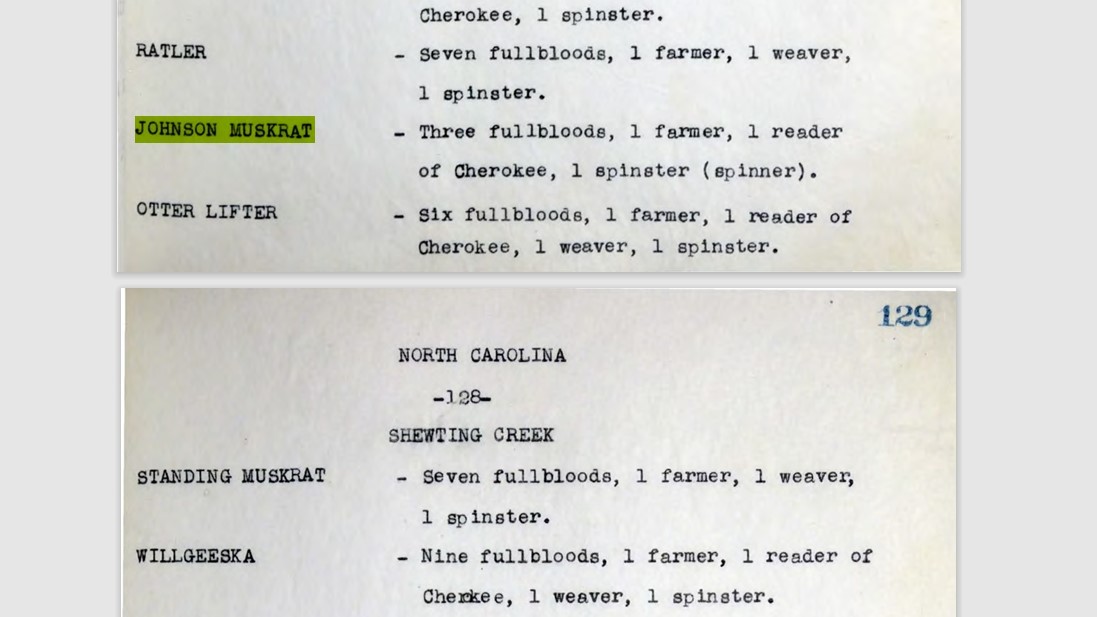
Fast‑forward nearly seventy years. By the time of the Dawes and Guion‑Miller Rolls, James, Rebecca, and Annie were gone. But James’s younger brother, Wilson Jr., was still alive and appears in the Guion‑Miller Roll. He listed his siblings, parents, and grandparents — and that gave me the crucial link I needed. His father, Wilson “Johnson” Sr., had lived in the Old Nation in the East. Now I had a name to search for in the 1835 Henderson Roll, taken before the removal.
The Henderson Roll wasn’t just a census — it was a property audit. The U.S. War Department used it to catalog Cherokee people and their homes, farms, and improvements, all in preparation for compensation and eventual seizure under the removal treaties. I used the Grant Foreman transcription — a familiar name to anyone from Muskogee — and scanned for my family.
There he was: my fourth great‑grandfather, listed in the community of “Shewting Creek” (Dani’sta‑la‑nv’yi), now submerged beneath Lake Chatuge near Hayesville, North Carolina, and the Georgia border.
Hayesville was the site of Fort Hembree, built in 1837 as a staging point for removal. In the summer of 1838, my relatives were arrested and marched eighteen miles from their homes to Fort Butler in Murphy, North Carolina — likely under guard, with rifles pointed, children crying, mothers pleading, fathers trying to reason or simply enduring.
I keep returning to Andrew Jackson’s infamous line: “John Marshall has made his decision; now let him enforce it.” The willingness to ignore the law — to trample due process and human rights — feels uncomfortably familiar today.
Learning more always makes me smarter. But it also makes me sadder. This is one of those times.
Leave a Reply