
“One of the biggest roles of science fiction is to prepare people to accept the future without pain and to encourage a flexibility of the mind. Politicians should read science fiction, not westerns and detective stories.” – Arthur C. Clarke
Translation: Greetings from the Land of the Anishinaabe, who are comprised of the Ojibwe (Chippewa), Odawa (Ottawa), and Potawatomi peoples.
Since moving to the historic land of the Anishinaabe (Michigan), I’ve visited the Detroit Institute of Art recently and saw a wonderful exhibition of Anishinaabe art, both historic and recent. It’s rekindled in me the urge to learn more about the various tribes from the greater area…many of whom were relocated to Kansas and eventually Oklahoma: Potawatomi, Shawnee, Ottawa, Sac, Fox, Wyandot/Huron, and Miami. I worked with several wonderful folks over my years in Oklahoma, whose ancestors were relocated, a Shawnee and a couple of Potawatomi.
Frequent visitors — all three of you — know that I’m a fan of speculative fiction. Speculative fiction invites us to imagine not just the future, but the past as it could have been. And once you start thinking that way, it’s hard not to wonder: what would this continent look like if European colonization had never happened?
That’s the jumping-off point for The Peacekeeper, a 2022 novel by B.L. Blanchard.
Reading The Peacekeeper while living on Anishinaabe land has made me reflect on the values embedded in this place — values that stand in stark contrast to the ‘capitalism at all costs’ ethos shaping modern America. Blanchard’s alternate history isn’t just a clever thought experiment; it’s a literary reminder that different value systems are possible, and some may be healthier than the one we inherited.
While it’s a murder mystery novel on its face, its real strength lies in the world-building that offers tantalizing hints about how America might be structured and governed, revealing a different set of world relationships and potentially a more equitable culture. Blanchard has said that the map at the front of the book is essentially 500 pages of world‑building on its own — a reimagined North America oriented with East at the top, as many non‑European cultures do:
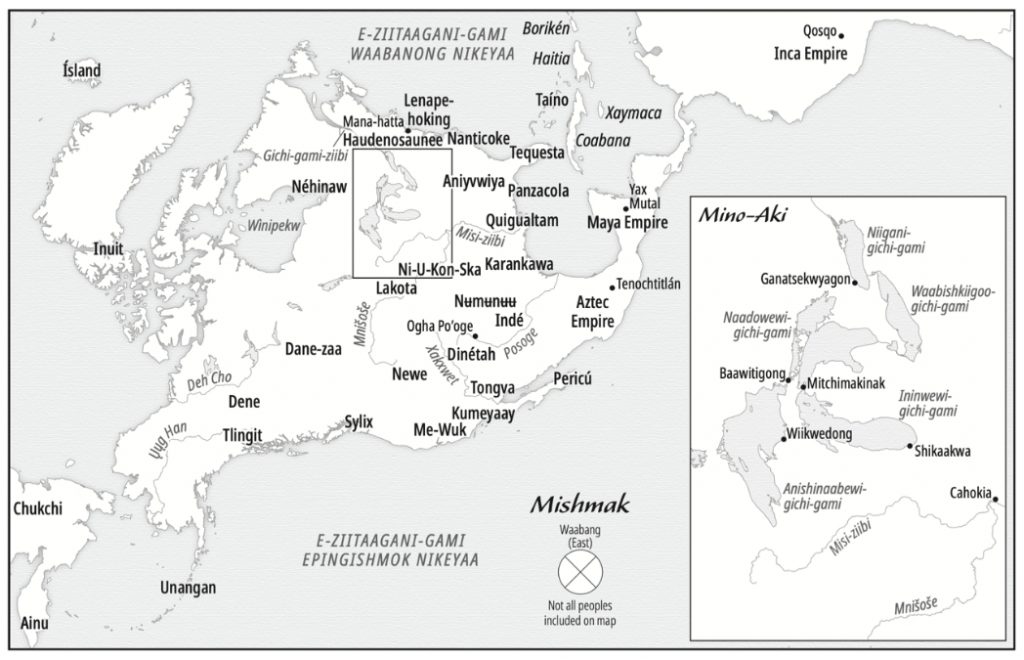
For my fellow Cherokee, note the lands of the Aniyvwiya, which are located around the state of Georgia.
Other than the murder, it’s apparently a peaceful continent, with commerce and tourism replacing warfare. One character is even a snowbird, going from Baawitigong (Sault Ste. Marie) to Panzacola (you can guess it) every winter.
I’m not going to spoil the ending for you, but there are a few snippets from the book that subtly describe a culture that in some ways offers a compelling alternative to the Western European frameworks we take for granted:
Land and Stewardship
“As if any person could actually claim to “own” the earth or any part of it. He knew about the attitudes that other backward countries had — they drew invisible lines around the land, claiming it for their own, and those were worth both living and dying for. Mino-Aki had no defined borders like that. No nation in Mishmak did. Such lines were not theirs to draw. You lived on the land; you didn’t own it.”
Housing and Community
“Homes were lived in and passed on to those who needed them, not owned and bequeathed to heirs…the recycling crew had arrived to take the remaining possessions that had not been distributed to her friends and loved ones: her television, furniture, baskets, dishes — all things that would serve someone else here on earth far better than her. The men from the recycling crew took everything away, cleaned it, repaired it, wasting nothing and throwing nothing away unless it was beyond repair or refurbishment. Furniture would eventually be distributed to those in the community who had need of any of the items — a bed to one family, a table to another, and so on until everything was parceled out.” This isn’t just a housing policy — it’s a worldview. It assumes that shelter is a communal resource, not a speculative asset. It assumes that a person’s worth isn’t measured by what they accumulate but by how they contribute.
“Shikakwa didn’t approach you gently from the horizon — it slapped you in the face in welcome. One moment, you were staring into the vast forests of trees, communal farms, and deer ranches interspersed with fields, and the next thing you knew, you were staring at a forest of buildings that had sprouted up out of nowhere.” Communal farms because no private ownership of farms. You could even imagine plantings of berry bushes, and the ‘Three Sisters’ crops. Deer ranches because there was never any cattle or horses imported. You can easily imagine bison still roaming the plains.
Justice and Responsibility
“Our system of Peacekeeping is one of restitution, of making people whole. That is all we come here today to do. This isn’t about assigning blame or punishing the Accused. Rather, this is about restoring the past.”
“The idea of mino-bimaadiziwin was a powerful motivator, and society was largely self-policing in that regard. If one person harmed another, it was the fault of just that person. It was the fault of the whole community. They had failed the perpetrator as well as the victim.”
“Every violation left a crack in the foundation of their society, no matter how small. Those small cracks could add up to large ones and eventually shatter. They saw what other parts of the world were like, where mino-bimaadiziwin was not the way of life. Where external punitive measures had to be taken to keep people in line, and where external incentives had to be used to bribe them to behave. She thought those were wrong, unnecessary. Helping Victims advocate for what would make them whole allowed for a system of peacekeeping and restitution that did not rely on such matters.”
And finally, this long speech by an Anishinaabe Economics Professor, at the great, 300-year-old university in Shikakwa (Chicago):
“Many do not realize this, but our society is far unlike any other in the world. In some parts of the world, you have the capitalists, who believe that everything has its price and people can be broken down into units of money and profit. It is exploitative and damaging. It turns society into haves and have-nots. There is prosperity but not equality.”
“Then you have, in other parts of the world, the communists, the reaction to capitalists, who believe that profit should not exist and that people cannot be boiled down into profits. The problem with that system, of course, is that it forces people to act against their own nature, to make everyone act in the most egalitarian manner. But as I am sure each of us can think of someone who we may feel does not deserve as much as we do, that it makes it a system that is difficult to enforce. Moreover, everywhere it has been tried, it has ended up being forced on people. Communism cannot participate in global trade, so it leads to chronic shortages. There is equality but not prosperity.”
“But here, among us? We have something better. We give. We give and we give and we give. We give each other the benefit of the doubt. We give each other what we have in surplus. We give each other what we cannot spare, because someone else is in greater need. This is, of course, the essence of economics — to provide your surpluses to others in exchange for their surpluses, which is far more efficient that trying to provide everything for yourself at any given time.”
“Unlike capitalists, however, we do not put a price on people. We do not give in the expectation of receiving something in return. We give because it is the source of mino-bimaadiziwin. We give because it is right. And because we give without expectation of receipt, our lives are better for it. We receive more than we give, at no greater cost than what we are able to provide. We’ve figured out what the capitalists have not, what the communists cannot.”
So here’s how the values shake out:
| Anishinaabe Values | Capitalist Values (as critiqued) |
|---|---|
| Mino‑bimaadiziwin (balance) | Growth at any cost |
| Reciprocity | Extraction |
| Collective responsibility | Individualism |
| Stewardship of land | Ownership as identity |
| Circularity | Waste as a byproduct |
| Restorative justice | Punitive justice |
What Blanchard describes isn’t utopian; it’s a coherent alternative. A circular economy grounded in reciprocity rather than accumulation. A society where ethics aren’t an afterthought to markets but the foundation that makes markets unnecessary in the first place.
Blanchard’s imagined society echoes real Anishinaabe teachings — especially the idea that a community thrives when generosity, responsibility, and balance guide decision-making.
We in the US used to have founding myths that guided us: the notion that all men are created equal, that justice would prevail, and that all could succeed given hard work and determination.
Now, we’re in another period where Billionaire/1%/Robber Barons are in their ascendancy, which makes me question whether our shared myth-making has come up short.
Clarke said science fiction prepares us for the future, but sometimes it prepares us for the past we lost — and the values we may need to reclaim. Blanchard’s alternate America isn’t just a different map; it’s a different moral imagination. One rooted in reciprocity, responsibility, and balance. If our own myths are failing us, perhaps it’s time to borrow better ones.

Well written!!!
You’re too kind, James!